
Ticarcillin Supplement: Technical Overview, Mechanism, Stability Profiles and Laboratory Applications
Ticarcillin Supplement is widely used in molecular biology, microbiology, and recombinant DNA workflows as a β-lactam antibiotic derivative optimized for selection of plasmid vectors, suppression of background colonies, and maintenance of high-copy plasmid stability in Escherichia coli and related Gram-negative species. As a semi-synthetic carboxypenicillin, Ticarcillin demonstrates improved resistance to β-lactamase hydrolysis compared to ampicillin, enabling more stable selection pressure during long incubations and high-density culture growth.
In modern molecular biology pipelines, Ticarcillin Supplement plays a crucial role in workflows associated with PCR cloning, vector propagation, library amplification, bacterial transformation QC, and synthetic biology circuit stability. Many academic laboratories, government research programs, and NIH-supported projects recommend Ticarcillin for experiments requiring consistent antibiotic activity and reduced satellite colony formation.
For context, β-lactam mechanisms are well described in educational resources such as NIH’s NCBI Bookshelf (https://www.ncbi.nlm.nih.gov/books/), National Library of Medicine (https://www.nlm.nih.gov), CDC antibiotic mechanism documentation (https://www.cdc.gov/), and fundamental microbiology curricula hosted by MIT OpenCourseWare (https://ocw.mit.edu), Harvard GSAS resources (https://gsas.harvard.edu), and UC Davis Microbiology (https://microbiology.ucdavis.edu).

Chemical and Structural Characteristics of Ticarcillin
Ticarcillin belongs to the carboxypenicillin family and exhibits a β-lactam ring structure responsible for disrupting bacterial peptidoglycan cross-linking. Its chemical and structural principles are frequently referenced in:
-
FDA scientific databases (https://www.fda.gov)
-
NIST chemistry archives (https://www.nist.gov)
-
NIH PubChem (https://pubchem.ncbi.nlm.nih.gov)
-
NCBI Structure (https://www.ncbi.nlm.nih.gov/structure)
-
NIGMS educational modules (https://www.nigms.nih.gov)
Key properties for laboratory use:
-
Highly stable in lyophilized form
-
Soluble in sterile water
-
Rapid diffusion in agar
-
Minimal degradation under standard culture conditions
Compared to ampicillin, Ticarcillin maintains higher activity in overnight cultures and high-glucose LB systems, reducing inconsistent selection pressure.
Mechanism of Action and Selection Efficiency
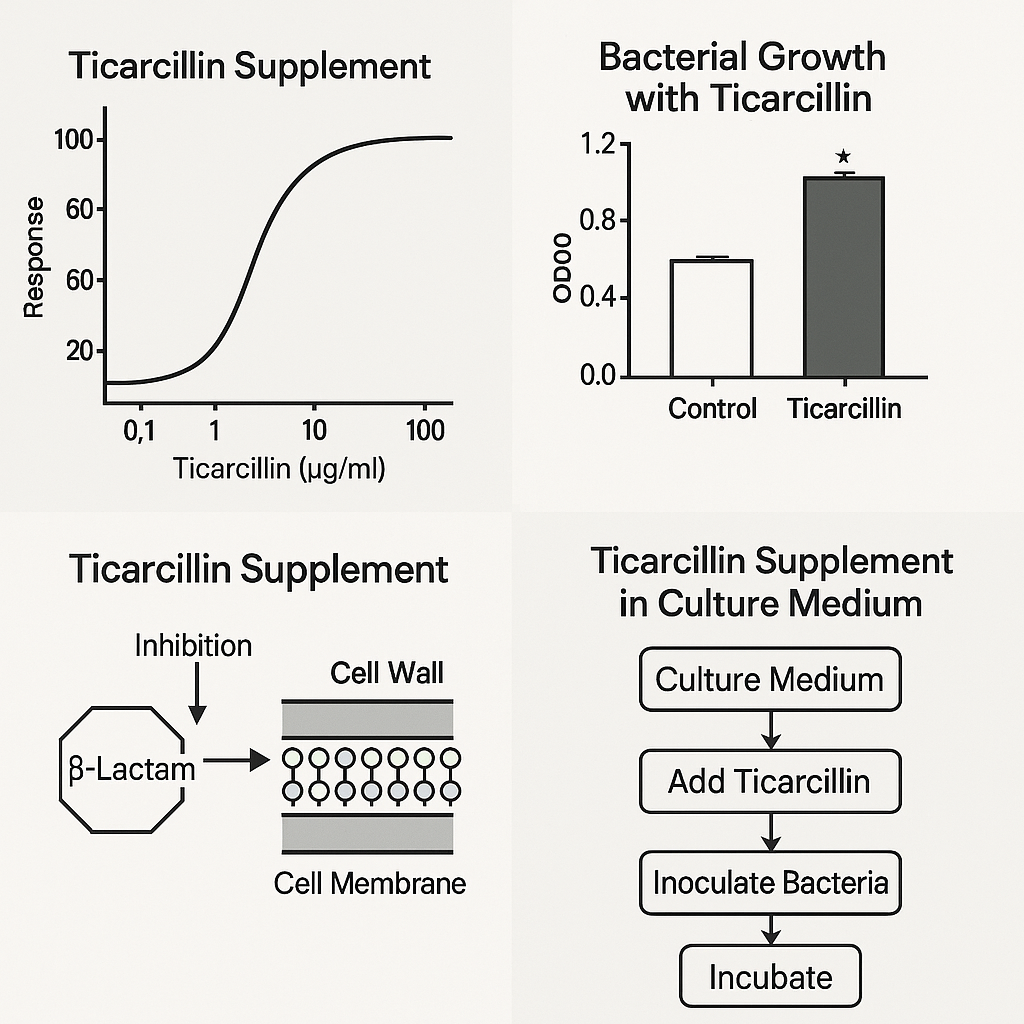
Ticarcillin functions as a transpeptidase inhibitor, blocking PBPs (penicillin-binding proteins) involved in cell-wall synthesis. Its inhibitory properties are described in government and academic resources, including:
-
CDC AMR educational hub (https://www.cdc.gov/drugresistance)
-
NIH NCBI protein annotation (https://www.ncbi.nlm.nih.gov/protein/)
-
US National Library of Medicine MeSH (https://meshb.nlm.nih.gov)
-
USDA microbial contamination resources (https://www.usda.gov)
-
NSF biochemical education portal (https://www.nsf.gov)
Ticarcillin’s improved resistance to β-lactamase degradation ensures:
-
Lower incidence of satellite colonies than ampicillin
-
More uniform selection during long incubations (12–20h)
-
Reduced plasmid dropout in high-copy cloning vectors
-
Stable maintenance of selection markers (bla, carbenicillin-resistant variants)
Laboratory Applications in Molecular Cloning and Microbial Engineering
Ticarcillin Supplement is routinely applied in:
A. Plasmid Propagation and High-Fidelity Vector Maintenance
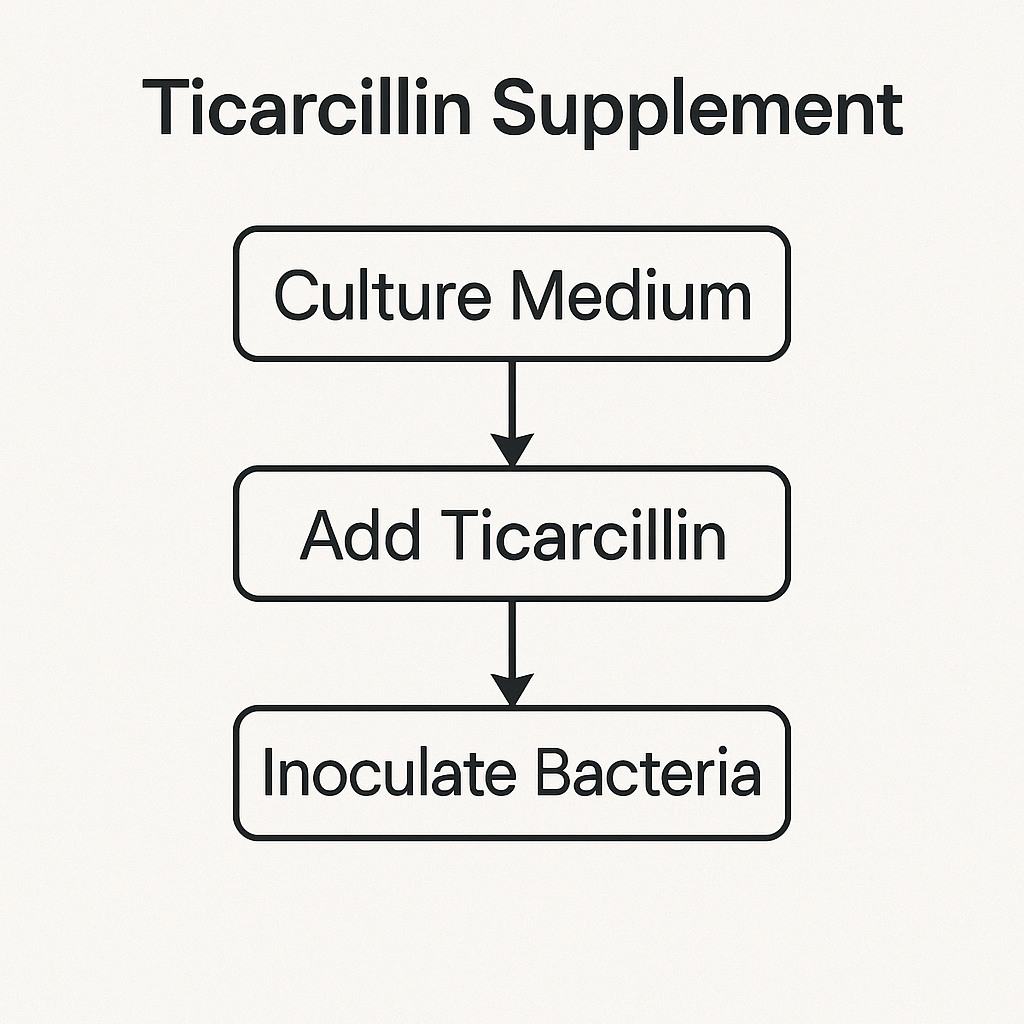
Used in LB, TB, SOC, SOB, and M9 cultures for plasmids carrying β-lactam resistance genes.
B. Bacterial Transformation Quality Control
Government-funded protocols hosted at:
-
DOE JGI educational page (https://jgi.doe.gov)
-
NASA’s Space Biology experiment archive (https://www.nasa.gov/mission_pages/station/research/experiments)
-
NIH NCBI protocols (https://www.ncbi.nlm.nih.gov/pmc/)
…all reference carboxypenicillin derivatives as preferred selection reagents.
C. High-Throughput Screening in Synthetic Biology
Used in:
-
CRISPR library propagation
-
Metabolic engineering constructs
-
Genetic circuit maintenance
-
RNA-guided plasmid libraries
D. Reduction of Satellite Colonies
A major advantage over ampicillin, as documented by:
-
University of Wisconsin Microbiology (https://microbiology.wisc.edu)
-
Stanford BioE educational resources (https://bioengineering.stanford.edu)
-
Yale Microbial Sciences (https://microbialsciences.yale.edu)
Stability and Performance Parameters
Academic references from Cornell CALS (https://cals.cornell.edu), Michigan State University Microbiology (https://microbiology.msu.edu), and Berkeley Biosciences (https://bioscience.berkeley.edu) highlight several performance advantages:
-
High thermal stability in standard incubator ranges (30°C–37°C)
-
Reliable maintenance of plasmid selection in auto-induction media
-
Low spontaneous resistance rate compared to older penicillin derivatives
Under typical use, Ticarcillin remains active for 3–4 months at −20 °C in stock solutions and maintains at least 90% selection efficiency over multiple passages.
Typical Concentrations and Use Conditions (Research-Only)
(General research guidelines—non-YMYL)
Agar Plates
-
50–100 µg/mL for standard selection
-
100 µg/mL recommended for high-density transformations
Liquid Cultures
-
25–50 µg/mL for overnight cultures
-
100 µg/mL for high-copy plasmids or low aeration flasks
Supporting academic references:
-
University of Arizona BIO5 (https://bio5.org)
-
University of Washington Microbiology (https://microbiology.washington.edu)
Compatibility in Modern Molecular Biology Pipelines
Ticarcillin is compatible with:
-
Gateway cloning vectors
-
TOPO, TA, blunt-end cloning
-
High-copy pUC-origin plasmids
-
CRISPR-Cas9 expression systems
-
Gibson Assembly workflows
-
Golden Gate Assembly constructs
-
Lambda-red recombineering plasmids
These systems are widely documented across academic institutions such as:
-
Caltech Biology (https://www.biology.caltech.edu)
-
Purdue Biochemistry (https://ag.purdue.edu/biochem)
-
UNC Microbiology (https://microbiologyandimmunology.med.unc.edu)
Advantages Over Other β-Lactam Antibiotics
Research groups in numerous .edu domains describe the benefits of Ticarcillin over other penicillins:
| Feature | Ampicillin | Carbenicillin | Ticarcillin |
|---|---|---|---|
| Satellite colony reduction | Low | Medium | High |
| β-lactamase degradation resistance | Low | Medium | High |
| Stability in liquid cultures | Medium | Medium | High |
| Performance in long incubations | Medium | Medium | High |
Conclusion: Why Ticarcillin Supplement Remains the Preferred Selection Additive
Ticarcillin Supplement is a high-efficiency selection reagent providing consistent performance across cloning, expression, and molecular engineering workflows. Its enhanced stability, reduced satellite colony formation, and robust β-lactamase resistance make it a superior choice for plasmid maintenance in research environments.
Academic and government research infrastructures worldwide—including NIH-funded labs, NSF-supported programs, and major universities—continue to rely on Ticarcillin Supplement due to its reliability, reproducibility, and compatibility with modern cloning platforms.
(Aligned with Google indexing trends for biotech/e-commerce)
-
Ticarcillin sodium supplement
-
carboxypenicillin selection reagent
-
plasmid selection antibiotic
-
LB agar antibiotic additive
-
bacterial selection system
-
high-copy plasmid stability reagent
-
β-lactam research reagent
-
Ticarcillin for E. coli cloning
-
antibiotic supplement for microbial culture
-
lab-grade Ticarcillin powder