
Peptide Control: High-Specificity Reference Material for Assay Validation, Protein Quantification, and Analytical Calibration
Peptide control (or peptide standard) is a synthetic peptide reagent used as a reference material in analytical workflows. It provides a stable, well-characterized signal for calibration, normalization and quality control in peptide and protein assays such as LC–MS/MS proteomics, HPLC and immunoassays.
Institutes like NIST maintain dedicated peptide mass spectral libraries and peptide reference materials to support these applications, for example the NIST peptide mass spectral libraries, NIST Standard Reference Database 1c and peptide mixtures such as RM 8321 “Peptide Mixture for Proteomics”. NIST+2NIST+2
This article gives a technical, SEO-optimized overview of peptide control reagents, focusing on:
-
What peptide controls are
-
Types of peptide controls and standards
-
Design and synthesis parameters
-
Use of peptide controls in LC–MS/MS
-
Use in immunoassays and epitope mapping
-
Storage, stability and documentation
Throughout the text, you will find multiple .edu and .gov hyperlinks for deeper reference.

What is a peptide control?
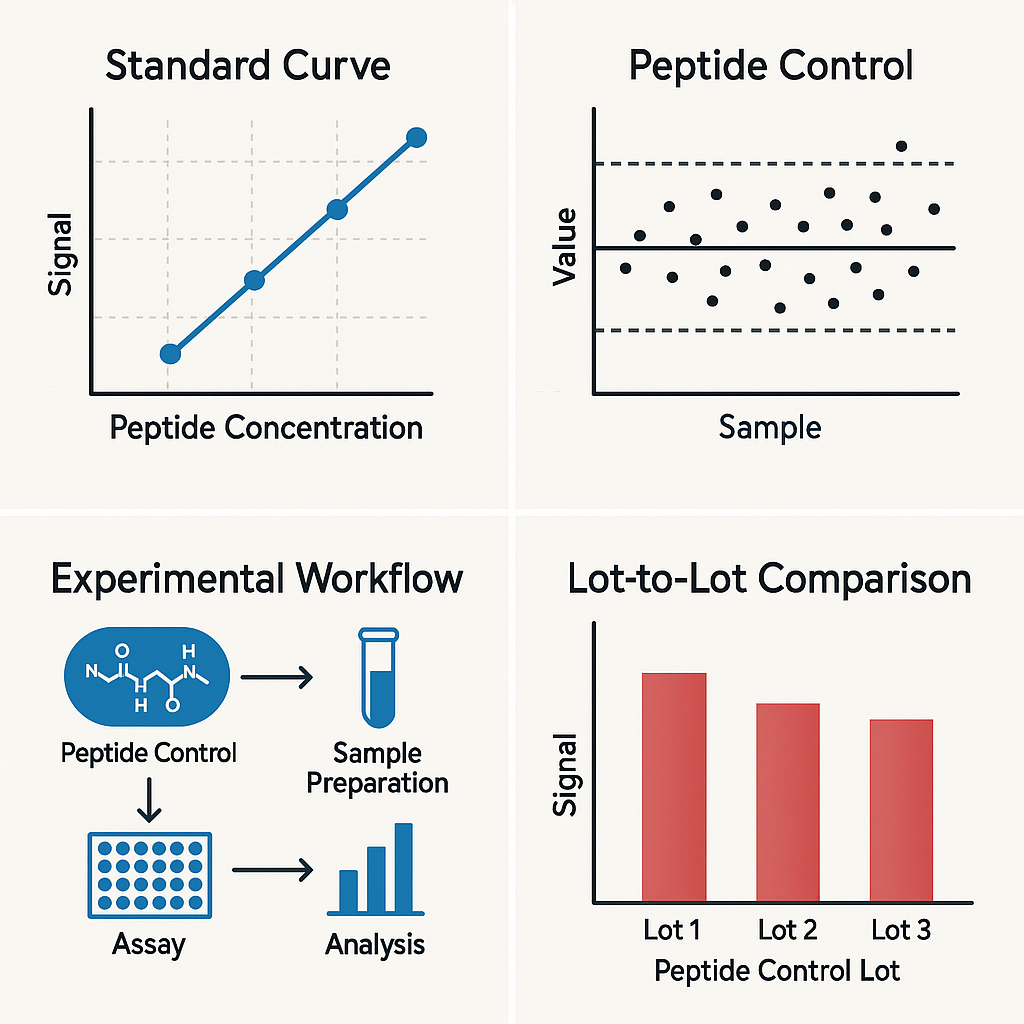
A peptide control is a synthetic peptide with known sequence, purity, concentration and physicochemical properties that is introduced into an analytical system to:
-
Verify correct instrument performance
-
Establish calibration curves
-
Monitor day-to-day assay precision and trueness
-
Detect matrix effects, losses and analytical drift
In LC–MS/MS proteomics and peptide quantification, reference laboratories use well-characterized peptide mixtures such as NIST reference material 8321 and SRM 998 Angiotensin I as benchmark peptide controls for method validation and amino-acid analysis calibration. INNTech+1
Guidelines for peptide reference standards and quality attributes have been published by expert groups and regulatory scientists, for example in open resources hosted at NCBI / PubMed Central and NIH. PMC+1
Why peptide controls are essential in analytical workflows
Control of mass spectrometry performance
In LC–MS/MS, peptide control standards are used to monitor:
-
Retention time stability
-
Mass accuracy and resolution
-
Fragmentation pattern reproducibility
-
Instrument sensitivity and limit of detection
Mass spectral libraries such as the NIST peptide fragmentation libraries and their description in the data.gov catalogue provide curated MS/MS spectra that serve as reference for evaluating peptide control signals and identification confidence. chemdata.nist.gov+1
Research articles on mass spectral analysis of synthetic peptides emphasize the need for well-defined peptide controls to evaluate identification algorithms and minimize false discovery rates. You can see typical strategies in open access articles archived at NCBI PMC. PMC
Quantitative proteomics and internal standards
For absolute quantification, peptide controls are often stable isotope-labeled internal standards spiked into each sample at a fixed amount. The ratio of endogenous peptide area to the labeled peptide control is used to calculate concentration, as described in multiple quantitative proteomics workflows hosted on PubMed and NCBI PMC. PubMed+1
Consensus recommendations for amino-acid analysis and peptide standardization stress the importance of in-house peptide control solutions and their traceability to reference methods. These are detailed in guidance papers available via NCBI PMC and NCBI peptide standardization resources. PMC+1
Classes of peptide control materials
In practice, “peptide control” can refer to several functional categories of synthetic peptides:
-
Calibration peptide standards
-
Used to generate calibration curves (e.g. 0.1–1000 fmol range).
-
Often traceable to certified or reference materials like NIST RM 8327 and SRM 998. INNTech
-
-
Internal standard peptide controls
-
System suitability controls
-
Complex peptide mixtures injected routinely to verify chromatographic separation, ionization and detector response.
-
Example: standard mixtures described in protocols from Rockefeller University and Bowdoin College. macromolecule-child.rockefeller.edu+1
-
-
Positive and negative control peptides in immunoassays
-
Defined linear peptides that either bind (positive control) or fail to bind (negative control) to a receptor, antibody or MHC molecule.
-
Examples of such controls are reported in immunoassay method development papers from Virginia Tech, URI and Emory University. VTechWorks+2digitalcommons.uri.edu+2
-
-
Multiplexed and universal peptide controls
Key design parameters for a robust peptide control
When designing a Peptide Control product for LC–MS/MS, HPLC or immunoassays, several technical parameters are critical:
-
Peptide sequence selection
-
Unique sequence (proteotypic peptide) without known post-translational modification sites for LC–MS/MS controls.
-
For immunoassay peptide controls, choose a validated epitope or binding sequence, drawing on epitope mapping data from academic resources such as Harvard and MHC-binding assays from URI. ADS+1
-
-
Length and composition
-
Typical length: 7–25 amino acids for LC–MS/MS peptide controls, balancing ionization efficiency and chromatographic behavior.
-
Avoid sequences with extreme hydrophobicity or multiple labile residues unless they are necessary for biological relevance.
-
-
Chemical purity and identity
-
Labeling strategy (for internal standards)
-
Solubility and formulation
Peptide control in LC–MS/MS proteomics
Peptide control for method development
In targeted and global proteomics, Peptide Control is central for:
-
Optimization of MRM/SRM transitions
-
Verification of chromatographic separation (peak shape, resolution)
-
Evaluation of ion suppression and matrix effects
Protocols for selected reaction monitoring are extensively described in step-by-step form at NCBI PMC and NCBI PMC quantitative method tutorials. PMC+1
Academic groups at Princeton University and MIT show how peptide standards can be combined with multiplexing strategies or used to optimize transitions for absolute quantification of protein panels. oar.princeton.edu+1
Multi-peptide and recombinant peptide controls
To reduce cost and simplify workflows, several groups use recombinant multi-peptide standards:
-
QconCAT and similar concatenated peptide genes
-
Cell-free synthesized isotopically labeled peptide mixtures
-
Recombinant standards like PAS-cal, presented as a generic peptide calibration tool at NCBI PMC. PMC
These strategies are described in methodological papers accessible via NCBI PMC peptide standardization and in targeted proteomics guidelines. PMC
System suitability and long-term quality control
Standard operating procedures often include:
-
Daily injection of a system suitability peptide control mix
-
Plotting retention time, peak area and signal-to-noise ratio against predefined acceptance ranges
-
Using control charts to detect drift, as in LC–MS method evaluations found at NCBI PMC and Scripps mass spectrometry resources. PMC+1
Peptide control in immunoassays and epitope mapping
Positive and negative peptide controls
In ELISA, bead-based assays and microarrays, peptide control reagents include:
-
Positive peptide controls: high-affinity binders that ensure the detection system is functional.
-
Negative peptide controls: unrelated peptides used to confirm background binding and specificity.
Method descriptions in university repositories, for example at Virginia Tech and Emory, provide concrete examples of how peptide controls are integrated into T-cell activation and immunoassay readouts. VTechWorks+1
Peptide arrays and pathway-level controls
In peptide microarrays, hundreds to thousands of peptide sequences are immobilized and probed with antibodies or other binding proteins. Synthetic peptide standards are used to:
-
Validate printing quality
-
Normalize array-to-array signals
-
Benchmark detection limits
Array-based approaches for pathway-level protein phosphorylation analysis are detailed in open-access studies at NCBI PMC, while high-throughput binding assays and immunoassay innovation are discussed in resources from UC San Diego and Upenn. PMC+2kummelgroup.ucsd.edu+2
Preparation, storage and stability of peptide controls
Lyophilization and reconstitution
Most Peptide Control products are supplied as lyophilized powders to maximize stability. Best practices include:
-
Lyophilizing from volatile buffers compatible with LC–MS (e.g. ammonium bicarbonate).
-
Reconstituting in LC–MS grade water or suitable organic solvent mix.
-
Avoiding repeated freeze–thaw cycles by aliquoting.
Practical examples of peptide standard preparation are provided in technical protocols from Rockefeller University and in method sections of LC–MS/MS applications archived at NCBI PMC. macromolecule-child.rockefeller.edu+1
Stability studies and reference materials
Reference institutions perform stability studies on peptide standards, evaluating:
-
Long-term storage at −20 °C / −80 °C
-
Short-term bench stability
-
Freeze–thaw robustness
These studies are documented in NIST reports such as 8327 Peptide Reference Material and SRM 998 Angiotensin I. INNTech+1
Technical reviews on synthetic peptide reference standards at NCBI PMC summarize vialing, lyophilization, analytical testing and long-term stability, which are directly relevant for designing and qualifying Peptide Control products. PMC
Data analysis, normalization and QC metrics using peptide control
After acquisition, peptide control signals are used in data processing workflows to ensure robust quantification:
-
Peak integration and transition ratios
-
Response factors and calibration curves
-
Construct calibration curves with peptide standards following guidance similar to the examples from MIT and Princeton. dspace.mit.edu+1
-
-
Normalization and batch correction
-
QC acceptance criteria
For e-commerce and product pages, the following keyword-rich summary block can help search engines index “Peptide Control” products:
Peptide Control – Synthetic Peptide Standard for LC–MS/MS, HPLC and Immunoassays
Peptide Control is a high-purity synthetic peptide standard designed for calibration, internal standardization and system suitability in peptide and protein assays. This peptide control supports quantitative LC–MS/MS proteomics, targeted MRM/SRM methods, HPLC peptide profiling and peptide-based immunoassays by providing a stable, well-characterized reference signal. Using a Peptide Control improves assay precision, trueness, linearity and reproducibility, and facilitates method validation, inter-run comparison and long-term quality control in research laboratories.